
Our Corrugated Packaging Manufacturing Facility
Eigene Aufnahme · KI-gestützt bearbeitet
Corrugator – Corrugated Board Production
Eigene Aufnahme · KI-gestützt bearbeitet
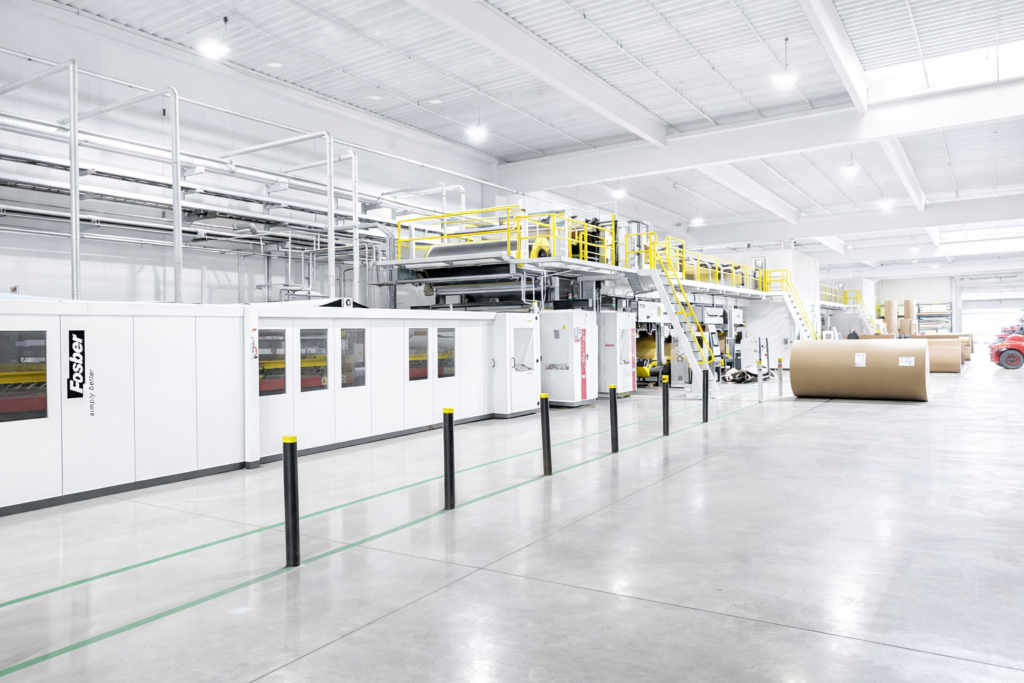
The heart of our corrugated board production is our approximately 120-metre-long corrugator, almost the length of a football pitch. This production line enables us to manufacture corrugated board at high speeds, in large formats and in a variety of specifications for subsequent converting into packaging.
With an annual production capacity of up to 150 million square metres, the corrugator is one of the key production systems at our manufacturing facility. Depending on the product and order, it can reach production speeds of up to 350 metres per minute. The maximum working width is 2,800 mm. We manufacture corrugated sheets in formats ranging from 250 × 500 mm to 2,760 × 6,000 mm. Depending on the format and production setup, the usable working width ranges from approximately 2,300 to 2,785 mm.
The corrugator can also process preprinted paper using registration mark control.
For packaging with convenient opening features, tear strips can be integrated directly during corrugated board production. Up to six strips can be applied simultaneously across the maximum working width. Strip widths range from 4 to 25 mm, with 4 mm and 15 mm widths available from stock as standard.
Our minimum order quantity for corrugated sheets is 300 m² or 100 linear metres. Short production and processing times enable delivery within approximately two to four days in many cases.
Printing
Eigene Aufnahme · KI-gestützt bearbeitet
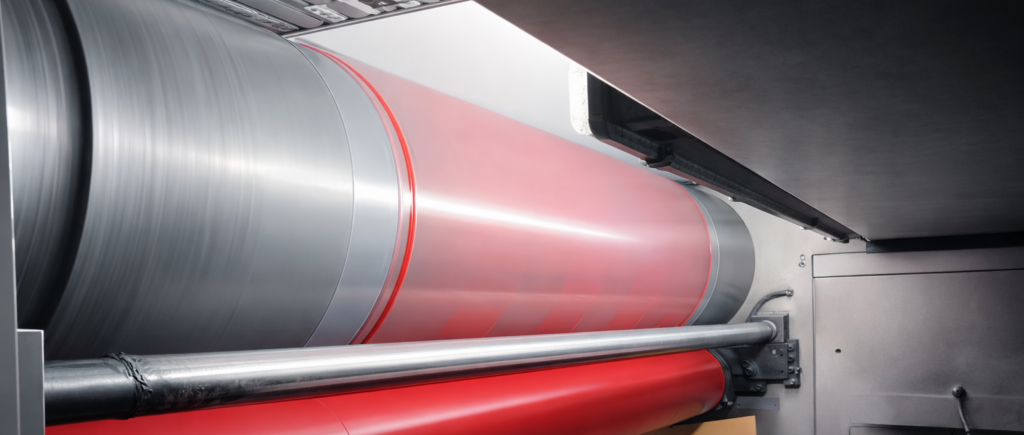
We offer our customers a range of high-quality printing processes for corrugated packaging. Depending on the required quantity, packaging design and print quality, our options include flexographic printing, offset printing, flexographic preprint and digital preprint. This allows us to produce everything from simple product markings to sophisticated, multicolour and photorealistic printed designs.
Our flexographic printing capabilities include one-, two-, three- and four-colour printing. Flexography is a relief printing process in which the raised printing areas of a flexible polymer plate transfer ink to the material. In simplified terms, the principle is similar to stamping. We can process print formats of up to 1,270 × 2,032 mm.
Offset printing is particularly suitable for premium, photorealistic graphics. A printed sheet is first produced and subsequently laminated onto corrugated board and further processed at our facility. This method enables highly detailed images, colour gradients and fine design elements, making it ideal for premium retail and display packaging.
Another option is flexographic preprint. In this process, the paper that will form the outer liner of the corrugated board is printed on a roll before corrugation. The preprinted paper is then combined with the fluted medium and inner liner on our corrugator. Preprint enables high-quality, consistent printing even for large production volumes. Formats with a sheet length of up to 2,060 mm can be processed.
By combining these printing technologies, we can tailor packaging graphics to the requirements of each product, packaging design and brand identity.
Die-Cutting
Eigene Aufnahme · KI-gestützt bearbeitet
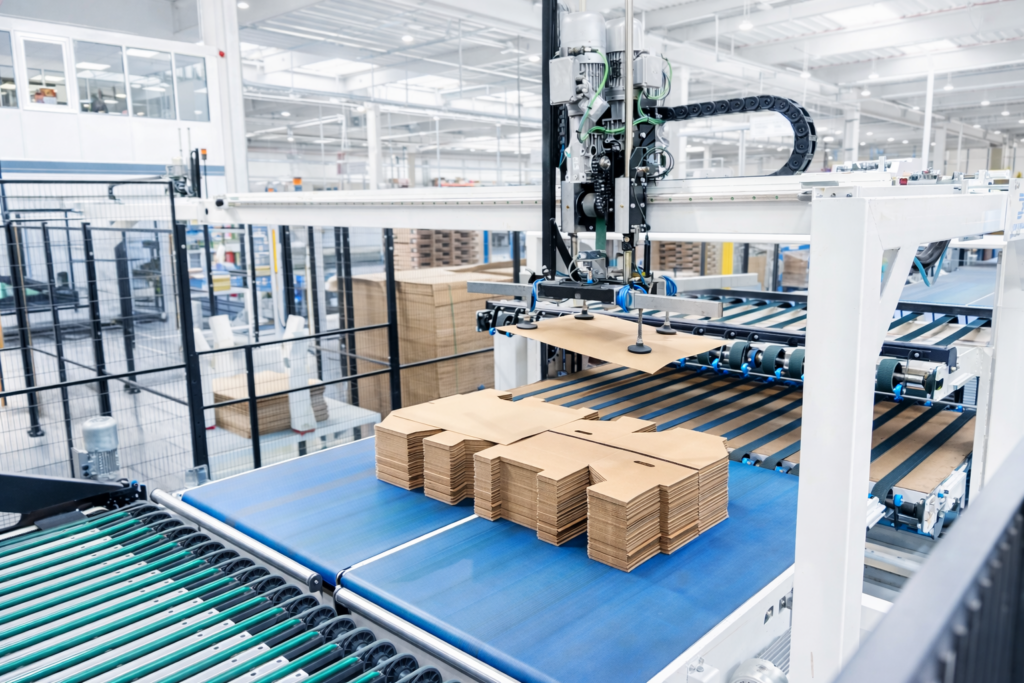
In our die-cutting department, we shape corrugated board with precision. This is where our corrugated sheets are converted into custom packaging blanks, contours, cut-outs and structural details for a wide range of packaging solutions.
We use high-performance flatbed die-cutting machines capable of processing sheet formats up to 1,500 × 2,100 mm. Depending on the machine, material thicknesses ranging from approximately 0.75 mm to 9 mm can be die-cut reliably.
Our machines are equipped with various technical systems to ensure stable and precise production. These include prefeeders for continuous sheet feeding, sheet squaring systems for accurate alignment and delivery braking systems for controlled stacking of die-cut sheets.
Additional equipment includes automated delivery systems and an online monitoring system for supervising production and checking quality during manufacturing.
Combining large processing formats, flexible material capabilities and automated feeding and monitoring systems allows us to produce both simple packaging blanks and complex die-cut constructions reliably and precisely.
Folding and Gluing
Eigene Aufnahme · KI-gestützt bearbeitet
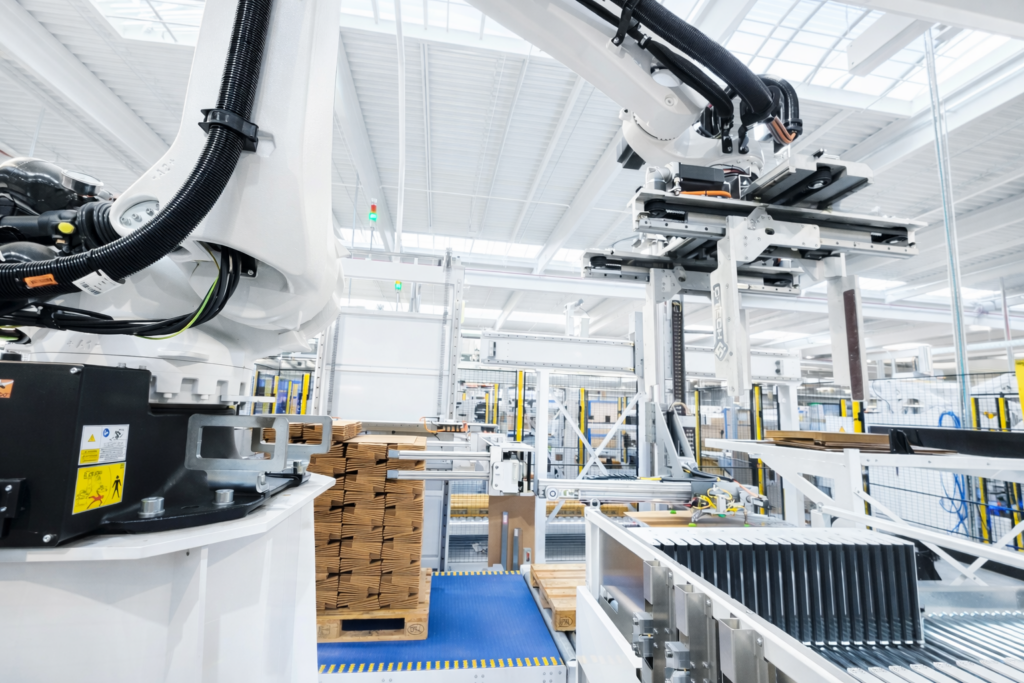
In our folding and gluing department, die-cut blanks are converted into finished packaging. We operate three folder-gluer machines and a fully automated gluing line. Depending on the box construction, we can produce standard straight-line glued boxes as well as three-, four- and six-point glued designs.
We process formats up to 1,300 × 2,080 mm. For more complex folding carton constructions, our equipment supports up to six-point gluing. One of our machines processes formats up to 1,030 × 1,575 mm and features a preset system that supports reproducible and efficient machine setup.
Increasing automation is a key focus of our gluing operations. On our fully automated gluing line, robots handle both the feeding and unloading of packaging. This enables consistent, efficient processing of large quantities while reducing manual handling.
Depending on the product and subsequent process, finished packaging can be bundled and automatically palletised. Our equipment accommodates a wide range of packaging sizes and supports a continuous production process from flat die-cut blanks to shipping-ready units.
Litho Lamination
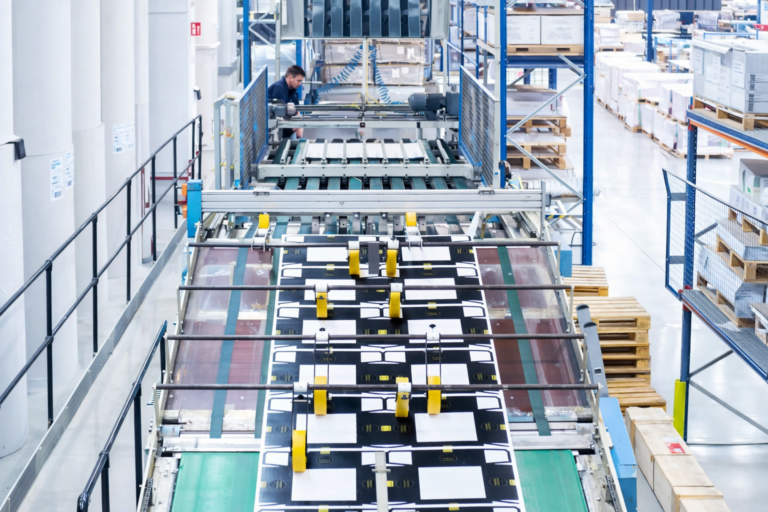
During lamination, printed or unprinted sheets are bonded to corrugated board. This combines high-quality surfaces with the strength and protective properties of corrugated packaging.
At our production facility, we can process formats up to 1,200 × 1,620 mm, using both single-wall and double-wall corrugated board.
Depending on the requirements, lamination can be carried out with either exposed or covered flute structures. This enables us to manufacture different packaging constructions, material combinations and visual finishes.
Lamination is particularly suitable for packaging requiring premium graphics, special surfaces or increased structural strength.
Eigene Aufnahme · KI-gestützt bearbeitet
Recycling
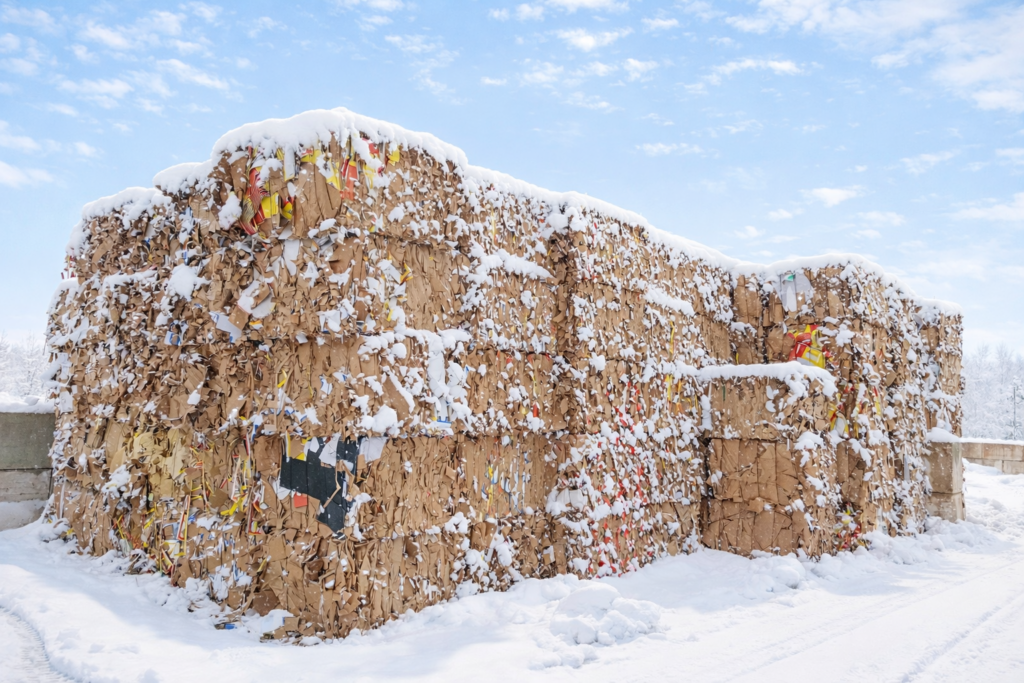
We consistently return production waste to the recycling process. Corrugated board and paper offcuts generated during manufacturing are collected and compressed into compact bales using our waste paper balers.
Transportation is organised efficiently: trucks delivering new paper to our production facility take compressed waste paper back to the paper mill on their return journeys. There, the material is processed and reused as a raw material for manufacturing new paper.
This creates a largely circular material flow. Paper arrives at our facility as a raw material, is converted into corrugated board and packaging, and production offcuts are returned to paper manufacturing. At the same time, empty truck journeys are reduced and existing transport routes are used more efficiently.
Eigene Aufnahme · KI-gestützt bearbeitet
Automated Material Handling
Eigene Aufnahme · KI-gestützt bearbeitet
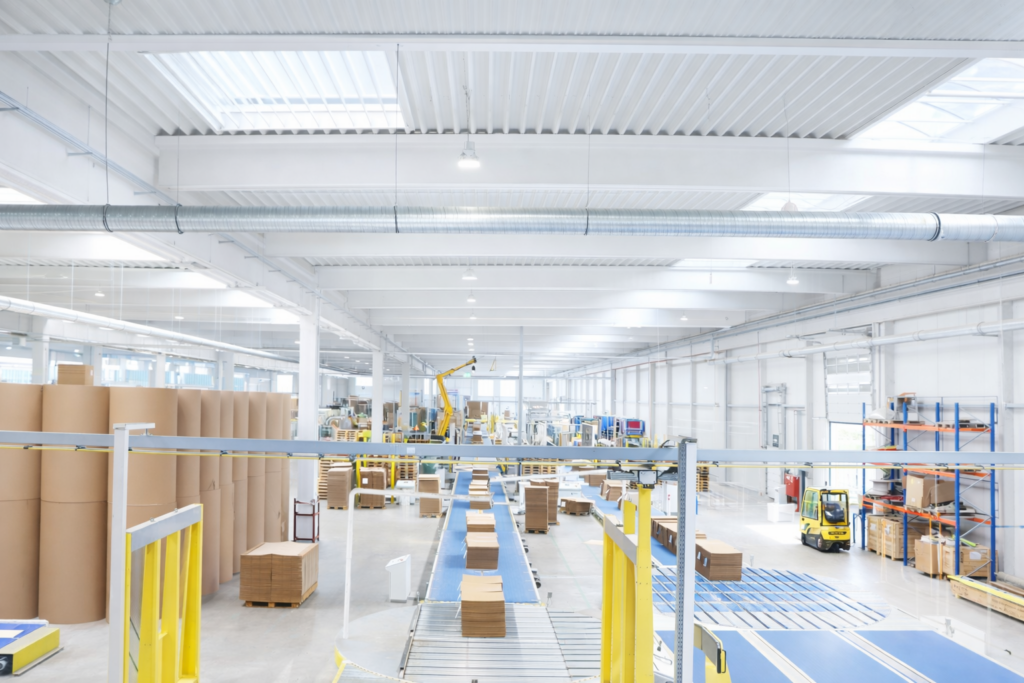
An efficient material flow connects our individual production departments and ensures that corrugated sheets, die-cut blanks and finished packaging move through our manufacturing facility with a high degree of automation.
Conveyor systems transport products between processing and packaging stations. Automatic pallet dispensers supply empty pallets as needed, while two transfer cars handle internal transport between different machines and production areas.
The system also includes automatic inserters, which can introduce specified materials or layer pads into the production process. For shipment preparation, we use compression and bundling machines that compact, secure and prepare finished packaging for transport.
Together, these systems create a largely continuous material flow, from corrugated board production through converting to bundled or palletised finished goods.
Our Production Facility
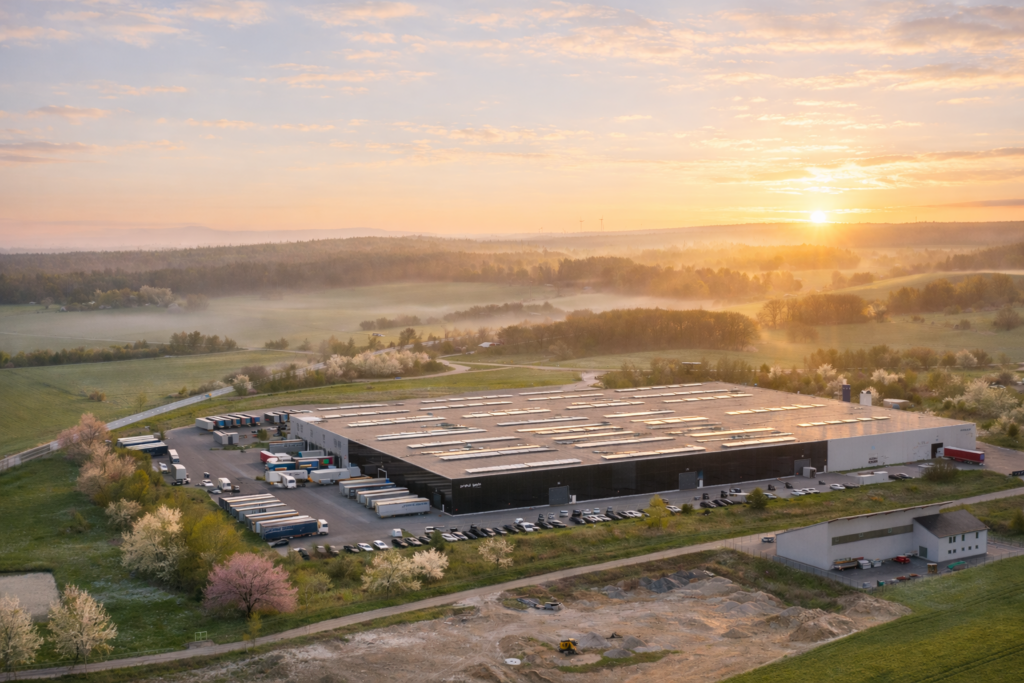
Our manufacturing facility at Laubacher Weg 14–16 in Diemelstadt-Rhoden was built in 2011. Today, it offers approximately 26,000 m² of production space, including an additional 10,000 m² added during the 2017 expansion.
The expansion was necessary to meet growing demand and increased production requirements. The new building was constructed using a prefabricated structural framework and connected directly to the existing production hall on two sides. It provided space for nine additional production lines, significantly increasing our manufacturing capacity.
A distinctive architectural feature is the translucent façade made of multiwall panels supported by a steel substructure. It makes use of natural daylight and creates changing lighting effects both inside and outside the building. Depending on the time of day and lighting conditions, the building’s appearance changes: it can glow from within, reflect its surroundings or blend subtly into the landscape.
Our production facility combines industrial functionality with distinctive, light-filled architecture.
Eigene Aufnahme · KI-gestützt bearbeitet